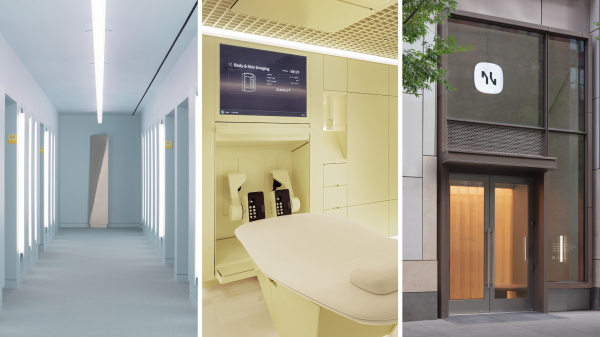
 Neko Health, the buzzy full body scan in the U.K. and Europe, is coming to the U.S.Courtesy of brandSave this storySave this story
Commercial full-body scans are all over your social feeds. They’ve been plugged by Kim Kardashian, Kate Hudson, Cindy Crawford, and more, but it’s hard to deny that they come with a hefty price tag. Now, a new company is debuting in the US, and its scan is a fraction of the cost of the competition.
The company, Neko Health, is launching in New York City after having multiple locations in Sweden and the UK. Neko Health’s signature scan will be $499. By comparison, a scan from celebrity-endorsed Prenuvo starts at around $1,200, with prices stretching up to $4,000 for more in-depth imaging.
Neko Health's service does more than scan your body—it involves a blood test, skin check, and other biomarkers, like blood pressure and heart rate. The company also doesn’t use MRI technology, which many others rely on; instead, it uses 2D cameras, thermal cameras, and depth sensors, along with other health metrics, to paint a picture of your physical health.
The benefits of such scans are debated (more on that later), but the interest in them remains high. Neko says they’ve had more than 350,000 wait-list entrants globally, so the appeal of a full-body picture of your physiology clearly extends worldwide. “New York felt like the right place to bring that idea to the US,” says cofounder and chief executive officer Hjalmar Nilsonne. “It’s a city where people are used to having access to the best of everything—and we think health care should be no different.” Ambitions for broadening the scan's availability stretch to Miami, Washington, DC, and San Francisco, says the company.
The drive behind all the interest in commercial scans is likely linked to the general public's desire to lead longer, healthier lives, according to Ernest Hawk, MD, head of the division of Cancer Prevention and Population Science at the University of Texas MD Anderson Cancer Center. “The whole population has learned that screening detection can be important for preventing cancer,” he says. “There's a hope that doing a whole-body evaluation might help people to identify things in an asymptomatic stage and thereby improve outcomes.” Couple that with strong social media campaigns, adds Dr. Hawk, and it's easy to see why Americans are suddenly into the idea.
Instagram content
Neko Health is tapping into that. “We started Neko Health with a simple belief: Understanding your health shouldn't mean waiting until something feels wrong,” Nilsonne tells Allure. “Our goal has always been high-quality preventive health care for everyone—and that means building the technology and clinical approach to make it genuinely accessible.”
While the field of commercial full-body scans includes companies like SimonMed and Function (which recently acquired fellow scanning company Ezra), many health care providers still aren’t convinced this is something the average American needs.
Every commercial scanning company offers something slightly different.
Prenuvo is one of the most popular companies and has a wide range of celebrity endorsements. The company offers a variety of screenings, including a head-to-thigh scan and blood test; a whole-body scan with a body-composition analysis; brain scan; and heart health scan.
Function/Ezra MRI, as part of its lowest-cost offering, will scan your head, neck, abdomen, and pelvis. Its top offering conducts MRI scans of nearly everything. You can tack on CT scans of your heart and lungs for additional costs.
SimonMed conducts a wide range of scans, from a “core” MRI scan to the core scan, along with head, neck, and spine imaging.
These scans are offered across the US: Prenuvo has locations in several major cities, including Washington, DC, Los Angeles, and New York; Ezra offers services in 40 states; and SimonMed is heavily concentrated in Florida, Arizona, Texas, and California.
Instagram content
These scans aren’t endorsed by any major medical association.
The American Medical Association (AMA) notes that these scans “have not been scientifically validated for screening purposes,” and stresses that research is needed to see if they’re worth your time and money.
An editorial in the Journal of the American Medical Association, published in May, warns that the use of commercial full-body scans should be “buyer beware.” And the American College of Radiology said in a 2023 statement that the organization “does not believe there is sufficient evidence to justify recommending total-body screening for patients with no clinical symptoms, risk factors, or a family history suggesting underlying disease or serious injury.”
Despite the lack of endorsements by the medical community, it’s hard to ignore some of the “success stories” that have come out of these scans. Last year, Emmy Awards executive producer Dionne Harmon revealed that a Prenuvo scan she had after seeing Kardashian’s endorsement detected her stage 3 lung cancer; Harmon had no symptoms at the time. Kardashian revealed that her scan detected a small brain aneurysm, which led to her getting other brain scans. (It’s not clear if she needed medical intervention beyond that.)
Doctors are still wary of commercial full-body scans.
Many argue that most people just don’t need these scans. “The whole-body MRI is indicated and makes sense in those that have known high-risk for diseases that are better detected by MRI—most tumors,” says Alexander McKinney, MD, chair of radiology at the University of Miami Health System. “However, the thing most people are five to seven times more likely to die from is cardiovascular causes, for which CT is better to detect those risk factors.” (Again, while some commercial scanning companies allow you to tack on CT scans, they’re not often built into the original packages.)
Breast cancer is also not typically detected through these scans, points out Richard Reitherman, MD, PhD, radiologist and medical director of breast imaging at Memorial Care Breast Center at Orange Coast Medical Center in Fountain Valley, CA. “Since whole-body MRI is not a contrast-enhanced study, it is especially not effective in screening for breast cancer,” he explains.
Dr. Reitherman also has concerns that some people will assume they’re healthy after having a commercial full-body scan and, as a result, skip scientifically validated screening tests. “The population that uses whole-body MRI as a substitute for specific proven screening tests such as contrast-enhanced breast MRI or CT scanning for lung cancer is at significant risk,” he says.
It is possible that a commercial full-body scan could detect a serious underlying health condition, says Dr. Hawk. “But there is an absence of conclusive evidence that it improves outcomes for anyone,” he adds. “Scientists measure benefit in terms of reduction of mortality. None of that exists at this point.”
Dr. Hawk also has concerns about the initial price of these scans, along with costs that someone may face if the scan detects something that may not be a big deal. “Any time a patient is in a screening program," he says, "you run the risk of finding something that may not be consequential in terms of improving the quality or length of someone’s life.”
These scans may also miss the full picture of a person’s health, Dr. McKinney says. “Whole-body MRI sounds sexy and can pick up most—not all—larger, actionable tumors and dementia, but it also tends to pick up many benign things that don’t need to be worked up,” he explains. “CT screening—lung, heart, vascular, stroke risks—picks up things that most of the population is much more likely to die from.”
If you have the budget for a full-body scan and are okay with the possibility of unnecessary follow-up scans, Dr. Hawk says you’re unlikely to be harmed by trying it out. “Indeed, it may find disease at an earlier stage and permit strategies to prevent the development of cancer,” he says. “There is that potential benefit. We just don’t have data yet on how beneficial this will be. In the future, I hope these are proven to be impactful and helpful.”
Leave a Reply